Every pixel has
its own opacity.
A cutout only answers keep or drop. In a Mistjar file every pixel has an opacity between 0 and 1: how much the glass wall lets through, how thin the smoke is, how soft the glow. Here is how that differs from a cutout, how each image is checked, and what it cannot do.
Why one-click cutouts fail
A background remover answers a yes-or-no question: is this pixel foreground or background? Keep it, or drop it.
A glass has no such answer. The wall of the glass is foreground, but what you see through it belongs to the background. The tool keeps it, and that patch of background becomes the color of the glass: a solid block that looks pasted onto any colored poster. Smoke, steam, glow and droplets fail the same way.
We ran the same image through three tools: u2net, the most common; BiRefNet, the strongest open-source model today; and the remover built into macOS and iPhone. In the areas that should let light through, all three assigned a median opacity of 1.00.


What true alpha is
Besides red, green and blue, every PNG pixel carries a fourth number: alpha, its opacity. At 1 the pixel covers the backdrop. At 0 the backdrop shows untouched. In between, the two are mixed in proportion.
Move your pointer over the glassTap the glass to read a single pixel. The air around it is 0, the empty glass wall about 0.1, the soda around 0.5, the lemon slice close to 1.

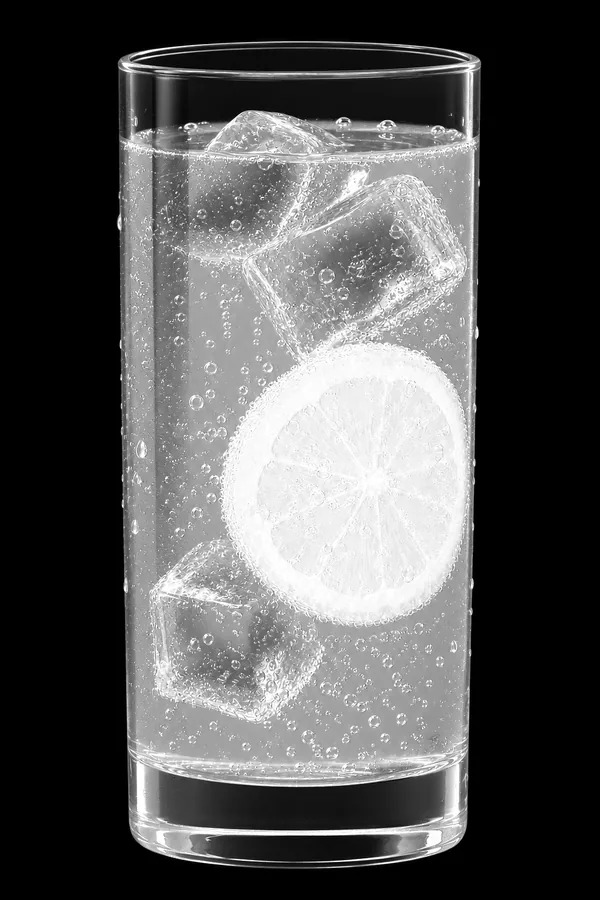
True alpha means that number is right: about a tenth on the empty glass wall, close to one on the lemon slice, zero in the air around it. So when you change the backdrop, what shows through the glass is that backdrop, with no white halo and no grey fringe.
How each image is checked
- Seven backdropsWhite, black, mid-grey, saturated color, a photo, and diagonal stripes. If the stripes show through the empty part of the glass, the alpha is real.
- By eyeWhite or black fringes, holes, anything opaque that should be clear, anything clear that should be solid. Whatever fails is redone.
What it cannot do
- Colored transmissionA PNG has a single alpha, so it cannot say that the light passing through is tinted. A strongly colored drink turns greyish on a contrasting backdrop, such as a blue drink on orange. Where this applies, the description says so.
- Large-format printEach image is about 1.5 megapixels: enough for screens, posters and menus, not for large-format printing. We do not upscale to pad the numbers.
- Glows on colored backdropsFire and glow are most accurate on pure black or white. On a colored backdrop they come out slightly darker than a true Screen blend.
What is in the file
- PNG · RGBAStraight (non-premultiplied) alpha at native resolution. Drop it into PowerPoint, Keynote, Canva, Photoshop or Figma as is. No blend mode needed.
- AI-generated markerEvery image is AI-generated. The page says so and so does the file metadata (IPTC Digital Source Type, plus the implicit label defined by China's GB 45438).
- Title, description, keywordsWritten into XMP in English and Chinese, so the file stays searchable in your asset manager.